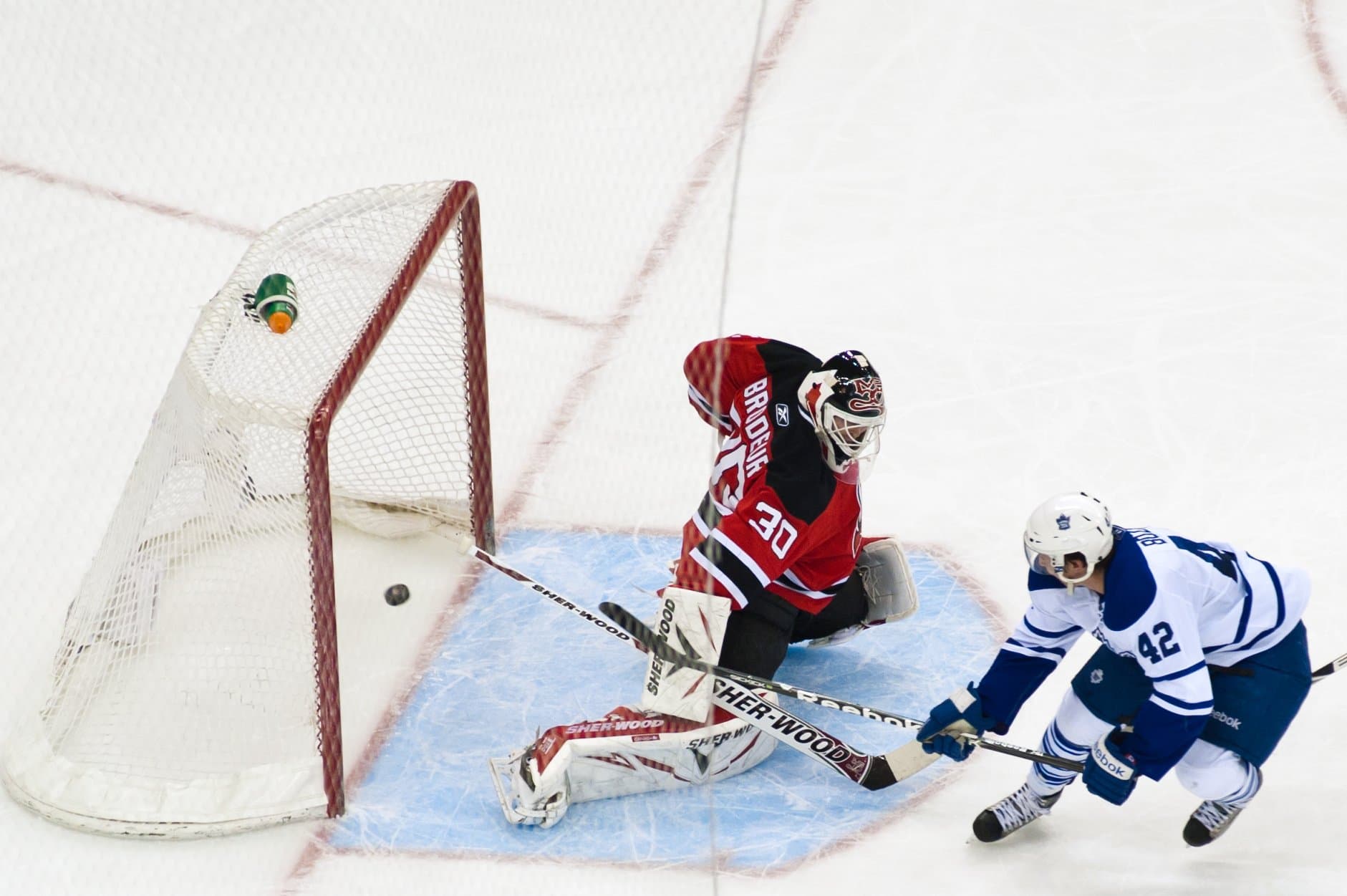
Photo: James DiBianco, Wikimedia Commons (BY-SA-2.0)
Two Maple Leafs Whose Trade Protection Changes July 1: Stolarz and Raddysh
Table of Contents
Maple Leafs trade protection shifts on July 1 — and it matters more than a signing
Free agency's opening day gets the headlines, but for the Maple Leafs the quieter calendar flip on July 1 may shape the roster just as much. Trade protection for two key players changes on this date, and the changes cut in opposite directions. Goaltender Anthony Stolarz becomes harder to move. Defenceman Darren Raddysh becomes essentially impossible to move. For a general manager still reshaping the edges of his roster, John Chayka's leverage just tightened.
Understanding how Maple Leafs trade protection works on July 1 is the difference between reading Toronto's summer as flexible or as increasingly locked in. Two names, two clauses, two very different consequences.
Anthony Stolarz: from an eight-team list to a 16-team list
Stolarz's no-trade clause expands on July 1 from an eight-team list to a 16-team no-trade list. In plain terms, the goaltender now gets to block trades to half the league rather than a quarter of it. That is a meaningful narrowing of the market for any team hoping to acquire him, and it arrives at exactly the moment his name has drawn interest.
The timing is not lost on anyone. Toronto's crease has been a talking point all offseason, and Stolarz — coming off a strong run as the No. 1 — is the most valuable trade chip in the goaltending picture. We argued in our piece on why the Leafs should only move Stolarz for a genuine upgrade that Toronto holds the cards here. The expanded clause reinforces that. Any deal now needs Stolarz's blessing on the destination, which shrinks the pool of realistic partners and strengthens his side of any conversation.
It does not make him untradeable. A 16-team list still leaves 15 clubs open. But it hands the player a bigger say, and it means Chayka cannot simply shop Stolarz to the highest bidder without checking the map first.
Darren Raddysh: the no-movement clause kicks in
The bigger lock is on the blue line. Raddysh, whom Toronto acquired and extended in a sign-and-trade this offseason on an eight-year deal worth $8.5 million per season, sees the full no-movement clause on that contract activate as the new league year begins. A no-movement clause is the strongest protection in the collective bargaining agreement: it blocks trades, waivers and demotions entirely. Raddysh cannot be moved without his say-so, and that protection runs for years.
We were skeptical of the term and dollars when the deal landed, laying out the case in our breakdown of the Raddysh sign-and-trade. The clause activating is the part that removes any easy exit. If the fit sours or the cap math tightens down the road, Toronto will not be able to simply reroute him. That is the trade-off Chayka accepted to win the bidding for a puck-moving right-shot defenceman in a market starved for them.
Why these dates exist at all
Trade-protection start dates are negotiated line items, not accidents. Players and agents fight for clauses to kick in on specific July 1 flips precisely so that a team cannot enjoy a window of easy tradeability before the protection engages. For veterans who have earned leverage, locking in a no-trade or no-move clause at the start of a league year is a core piece of the deal — sometimes as valuable to them as the dollars.
For the club, agreeing to those dates is the cost of doing business with players who have options. The Leafs have handed out several such clauses over the years, and every July 1 a few more activate. Tracking them is part of understanding what Chayka can and cannot do. The full contract picture, including term and clause details, lives on our contracts page.
A primer on how these clauses shape a roster
It helps to understand why front offices track these dates so obsessively. A no-trade or no-movement clause does not just protect a player; it reshapes the entire trade market around him. When Toronto shops a protected player, it is not negotiating with 31 teams — it is negotiating with whichever subset the player is willing to join, and those teams know it. That knowledge changes the price. A rival can lowball, confident that the Leafs cannot simply take a better offer from a club the player has blocked.
The clauses also interact with the cap in subtle ways. A no-movement clause blocks waivers, which matters if a contract ages badly and a team would otherwise want to bury part of it in the minors. That escape hatch closes the moment the clause activates. For Raddysh, on a long, rich deal, that means Toronto has no cheap way out if the contract underperforms — the money is on the NHL books, guaranteed, for the duration.
This is the hidden cost of winning free-agent and trade auctions for good players: the protection you grant to close the deal is the same protection that limits you later. Every clause is a bet that the player will still be worth having when the flexibility is gone. Toronto has now made that bet twice on its blue line, and once more in net.
What it means for Chayka's summer
Put the two together and the message is clear: Toronto's roster is becoming more fixed as July arrives, not less. Stolarz is harder to move and holds more sway over where he would go. Raddysh is effectively immovable. Both were assets Chayka might theoretically have flipped as part of a larger reshape; both just got stickier.
That is not automatically bad. Protection clauses are how teams sign and keep good players, and both Stolarz and Raddysh project as contributors on next season's team. But it does narrow the paths available. If Chayka wanted optionality — the ability to pivot these contracts into something else at the trade deadline or next summer — that optionality just shrank.
The one blueliner whose situation has not changed is Morgan Rielly, who already carries a full no-movement clause and has controlled his own market all along. We covered how that plays out in our look at Rielly's trade list. Add Raddysh's freshly activated clause to Rielly's, and Toronto now has two protected right-and-left-shot veterans anchoring a defence that Chayka has spent the summer trying to make younger and faster.
What's next
None of this stops the Leafs from being active in free agency or on the trade market. It simply defines the edges. Expect Chayka to work around these clauses rather than through them — targeting unprotected depth, pending free agents, and players on other rosters rather than trying to unwind the commitments he has already made.
The broader goaltending question still looms largest. With Stolarz now carrying expanded protection and the crease behind him thin, Toronto's options are as much about who they add as who they might subtract. We mapped that depth in our look at the crease behind Stolarz, and it remains the storyline to watch. July 1 did not add a player to Toronto's roster this morning. It did quietly redraw who is staying put.
Frequently Asked Questions
Whose trade protection changes for the Maple Leafs on July 1, 2026?
Two players: goaltender Anthony Stolarz, whose no-trade clause expands from an eight-team list to a 16-team list, and defenceman Darren Raddysh, whose full no-movement clause activates on his new eight-year contract.
What is the difference between a no-trade and a no-movement clause?
A no-trade clause lets a player block trades to a set list of teams. A no-movement clause is stronger — it blocks trades, waivers and demotions entirely, meaning the player cannot be moved anywhere without granting permission.
Does Anthony Stolarz's expanded clause make him untradeable?
No. A 16-team no-trade list still leaves 15 clubs Stolarz cannot block, so a deal remains possible. It does give him a bigger say in the destination and shrinks the pool of realistic trade partners for Toronto.
What is Darren Raddysh's contract with the Maple Leafs?
Raddysh signed an eight-year extension worth $8.5 million per season as part of a sign-and-trade this offseason. The contract's full no-movement clause activates on July 1, making him effectively impossible to trade without his consent for years.
Why do trade-protection clauses start on July 1?
Start dates are negotiated so a team cannot enjoy a window of easy tradeability before protection engages. Players and agents fight for clauses to activate at the flip of the league year, when the new season officially begins.
Which other Maple Leafs have full no-movement clauses?
Morgan Rielly already carries a full no-movement clause and has controlled his own trade market throughout the offseason. With Raddysh's clause now active, Toronto has two protected veteran defencemen anchoring the blue line.


