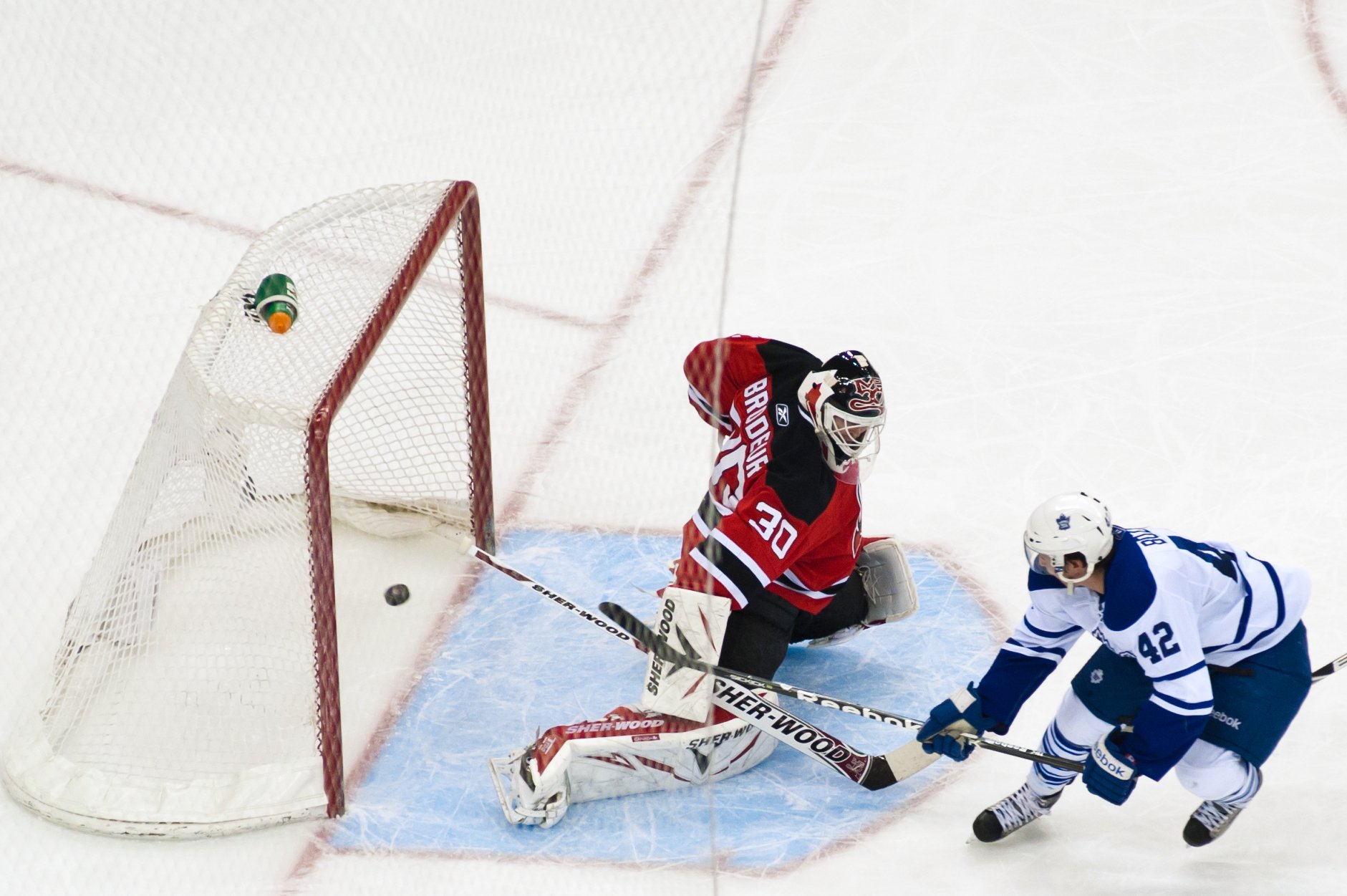
Photo: qmnonic, Flickr (BY-2.0)
Maple Leafs Goaltending Depth Got Thin Fast: Stolarz, Hildeby, Akhtyamov and an 84-Game Grind
Table of Contents
Maple Leafs goaltending depth is suddenly the offseason's quietest risk
Two trades reshaped the Maple Leafs goaltending depth chart this month, and not in the direction most people expected. By moving Joseph Woll to the Philadelphia Flyers and then flipping Samuel Ersson to the Ottawa Senators, John Chayka turned what was the deepest position on the roster in March into one of its biggest question marks at the end of June. Anthony Stolarz remains the clear starter. Behind him, the Leafs are now betting on a backup who has never carried an NHL workload and a prospect who was lighting up the AHL playoffs a few weeks ago.
That is a defensible plan. It is also a bold one for a team that wants to climb back into the playoff picture, especially with the league moving to an 84-game schedule that adds wear to every crease in the NHL. The Maple Leafs goaltending depth question is no longer about a logjam — it is about whether Toronto has enough proven netminding to survive a long season.
How Toronto went from surplus to scarcity
Rewind a few weeks and the crease was crowded. Stolarz, Woll, Ersson and a pair of intriguing youngsters gave Toronto more goaltending than it could roster, the kind of logjam that practically demanded a trade. Chayka made two. First he dealt Woll to the Flyers in his first big swing as GM, then he sent Ersson to Ottawa for a 2027 fifth-round pick. The logic was sound on its own terms: you cannot pay and play four goalies, and leveraging a surplus to accrue assets is exactly what a smart front office does.
Chayka has framed it as turning organizational depth into flexibility and young assets, and on a spreadsheet the trades make sense. But subtraction has consequences. Toronto did not just trade depth — it traded its two most experienced insurance options inside a single offseason. What's left is a top-heavy depth chart that leans hard on one established goalie and asks a lot of everyone behind him.
Anthony Stolarz is the starter — and the swing factor
Stolarz is a good goalie when healthy, and "when healthy" is the operative phrase. He has been excellent in stretches for Toronto and gives the team a legitimate starter's floor. The concern has never been his quality; it is his durability. Stolarz has a history of injuries that have cost him chunks of seasons, and a goalie with that profile is precisely the kind you want to surround with proven backups — not unproven ones.
An 84-game schedule sharpens the point. Even durable starters rarely play more than 55 to 60 games, which means a true No. 2 has to be ready for 25-plus starts, and a No. 3 has to be NHL-capable rather than a break-glass emergency. If Stolarz misses time — and his history says it is more likely than not — the entire season tilts onto goalies who have never been asked to carry the load. That is the bet Chayka has made, and it is the single biggest variable on the roster heading into camp.
Dennis Hildeby earned the backup job
The good news for Toronto is that Dennis Hildeby played his way into trust. In 2025-26 the big Swede posted a 2.86 goals-against average and a .914 save percentage in his NHL looks, numbers strong enough that he, by most accounts, outperformed the more experienced options ahead of him. He is no longer waiver exempt, which adds urgency to keeping him on the NHL roster, and as the depth chart stands he is the logical choice to open the year as Stolarz's backup.
The caveat is sample size. A .914 in limited duty is encouraging, not conclusive. Hildeby has never been handed 25 or 30 starts in an NHL season, and the gap between flashing in spot duty and holding up over a four-month grind is where a lot of promising goalies stall. The Leafs are projecting his strong cameo forward across a much larger role. It might work. It is still a projection.
His physical tools at least give the bet a foundation. At six-foot-seven, Hildeby takes up an enormous share of the net and tracks pucks better than most goalies his size, which is exactly the profile that tends to age well once the reads catch up to the frame. The Leafs clearly believe the development curve is pointing up. The fair counter is that betting a playoff push on an unproven backup is a different proposition than penciling him in as a luxury third option, which is the role he was originally being groomed for.
Artur Akhtyamov is the wildcard
The most exciting part of the post-trade picture is Artur Akhtyamov. The Russian netminder was outstanding during the Marlies' Calder Cup run, posting a .922 save percentage and a 2.18 goals-against average across 11 playoff games. His rapid development is, by several accounts, a big part of why the organization felt comfortable moving Woll in the first place — the pipeline gave Chayka cover to sell high.
That said, AHL playoff brilliance and NHL readiness are different things. Akhtyamov has earned a real look, and he could absolutely force his way into the conversation during camp. But asking a goalie to make the jump from his first strong pro playoff run straight into meaningful NHL minutes on a team chasing a playoff spot is a lot. The realistic 2026-27 plan is Akhtyamov as the third goalie and a midseason call-up option, not a Game 1 fixture — with the upside that he proves that timeline too conservative.
The Bobrovsky door is still open for a reason
This is why Chayka has pointedly left the door open on a goaltending addition. Toronto has been linked to veteran free agent Sergei Bobrovsky, and while a 38-year-old on the wrong side of his prime is an imperfect fit, the logic is clear: the Leafs need a proven body to bridge the gap between Stolarz's durability questions and the inexperience behind him. We broke down the Bobrovsky angle earlier this month, and the case has only strengthened now that Woll and Ersson are both gone.
A veteran on a short, cheap deal would let Hildeby and Akhtyamov develop at a sane pace rather than being thrown into the deep end out of necessity. It would also protect the season against the Stolarz injury scenario that every Leafs fan is quietly bracing for. With more than $18 million in cap space and a goaltending market that includes several experienced names, Chayka has both the room and the motive to add one more body before camp.
What's next
Free agency opens July 1, and goaltending is one of the few areas where the Leafs could realistically dip in without blowing up their disciplined plan. Watch whether Chayka signs a veteran No. 2 or 3, or whether he truly commits to Stolarz-Hildeby-Akhtyamov and banks the savings for a centre. Either path is defensible; one is far riskier than the other.
The Maple Leafs goaltending depth story is the offseason's quietest subplot precisely because Stolarz is good enough to mask it on paper. But a starter with an injury history, a backup with a tiny NHL sample, and a prospect one strong playoff run removed from the minors is a thin foundation for an 84-game season. Chayka cleared a logjam and created a question. How he answers it before camp will say a lot about whether this roster is built to make the playoffs or just to look good in July.
Frequently Asked Questions
Who are the Maple Leafs goalies for 2026-27?
Anthony Stolarz is the established starter. After trading Joseph Woll to Philadelphia and Samuel Ersson to Ottawa, Toronto's depth behind Stolarz is Dennis Hildeby, who is in line for the backup job, and prospect Artur Akhtyamov. The Leafs may still add a veteran in free agency.
Why did the Maple Leafs trade Joseph Woll and Samuel Ersson?
Toronto had a surplus in net and could not roster four goalies. GM John Chayka leveraged that depth into assets, trading Woll to the Flyers and Ersson to the Senators for a 2027 fifth-round pick. Artur Akhtyamov's emergence in the AHL gave the front office confidence to sell high.
How did Dennis Hildeby play in 2025-26?
Hildeby posted a 2.86 goals-against average and a .914 save percentage in his NHL appearances, strong enough to play his way into the backup conversation. He is no longer waiver exempt, but he has never carried a full NHL starter's-backup workload, so the sample is still small.
Is Artur Akhtyamov ready for the NHL?
Akhtyamov was outstanding in the Marlies' 2026 Calder Cup run, posting a .922 save percentage and 2.18 goals-against average across 11 playoff games. He has earned a look, but the realistic plan is third goalie and call-up option for 2026-27 rather than a Game 1 fixture.
Will the Maple Leafs sign a goalie in free agency?
Chayka has left the door open on a goaltending addition, and Toronto has been linked to veteran Sergei Bobrovsky. With Stolarz's injury history and limited experience behind him, a short, cheap veteran deal would protect the season and let the young goalies develop at a reasonable pace.
How many games is the NHL schedule in 2026-27?
The NHL is moving to an 84-game schedule, up from 82. The longer season adds wear on every team's crease and raises the importance of having at least three NHL-capable goalies, which is part of why Toronto's thinned-out depth chart is a real concern.