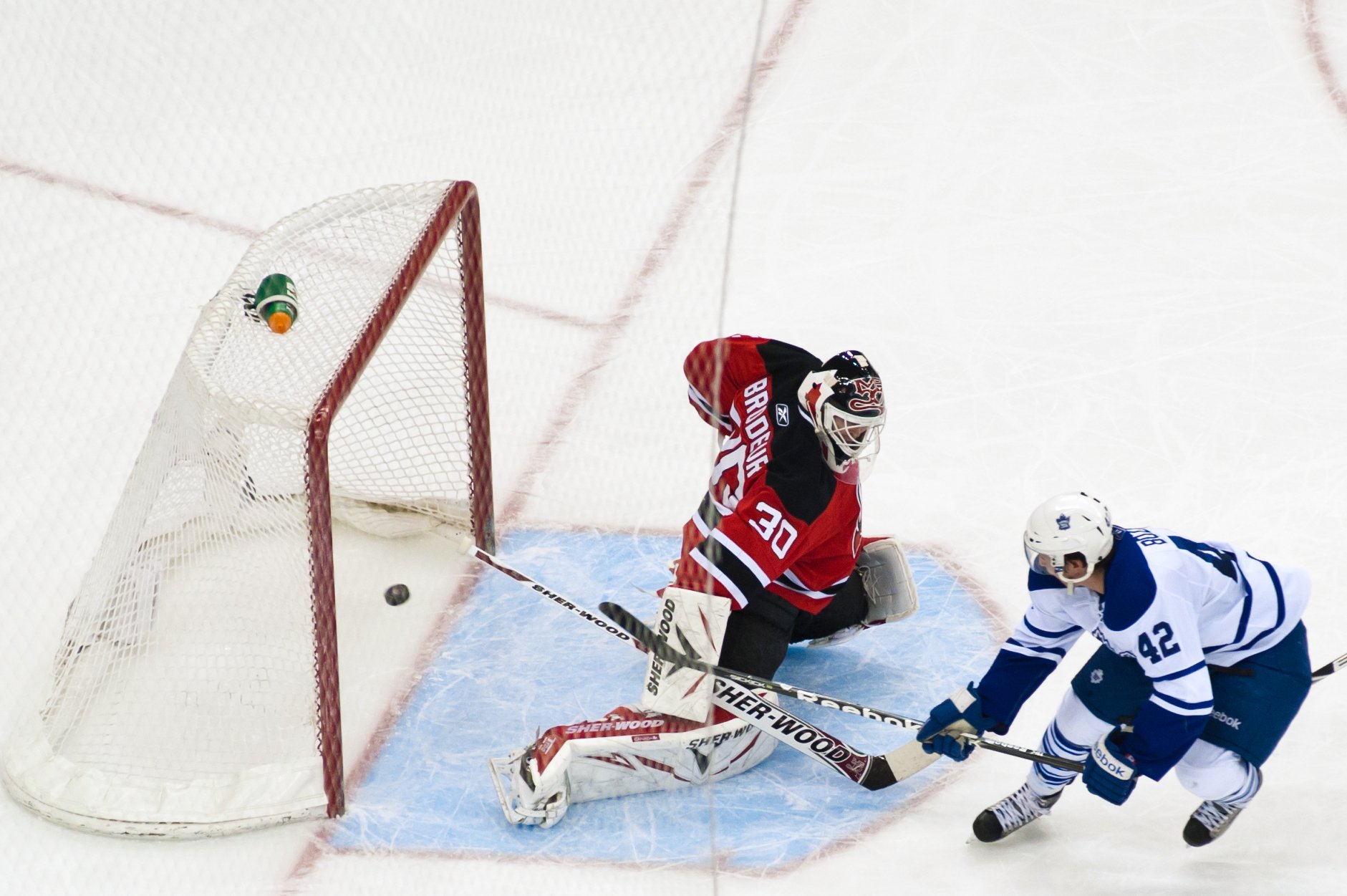
Photo: Adam Bishop, Wikimedia Commons (BY-SA-4.0)
Maple Leafs Re-Sign Troy Stecher to a Two-Year Deal Worth $2.7 Million
Table of Contents
Maple Leafs Lock Up Troy Stecher Two Days Before Free Agency
The Maple Leafs re-signed Troy Stecher to a two-year contract worth a reported $2.7 million on Monday, keeping the right-shot defenceman in Toronto two days before the free-agent market opens. The deal carries a $1.35 million average annual value, and it takes one of John Chayka's smaller offseason items off the board before the noise of July 1 takes over.
It is not the kind of signing that moves the needle for a fan base still digesting a McKenna draft pick and a summer of churn on the back end. But it is a sensible piece of housekeeping. Stecher was a useful depth body for the Leafs last season, and bringing him back on a cheap, short deal fits the cap-conscious approach Chayka has preached since the day he took the job.
What Troy Stecher Brings Back to Toronto
Stecher, 32, skated in 58 games for the Maple Leafs last season, recording 14 points on three goals and 11 assists. Toronto claimed him off waivers from the Edmonton Oilers on November 15, and he settled in as a reliable seventh-defenceman-plus type — the kind of player who can slot into the third pair, kill penalties in a pinch, and not look out of place when injuries thin the blue line.
He is not flashy. Stecher is a 5-foot-10 right-shot defender who wins his minutes through positioning, a quick first pass, and a willingness to block shots and defend the front of the net against bigger forwards. For a Leafs blue line that has skewed toward puck-movers, that profile has value, especially in a bottom pairing role where the priority is competence rather than upside.
The money tells the story of how Toronto views him. The $1.35 million cap hit is nearly double the $787,000 he earned on his previous two-year deal with Edmonton, a modest raise that reflects a real NHL role without overcommitting term or dollars. On a roster where Chayka is guarding every dollar of his roughly $22 million in cap space, a sub-$1.5 million depth defenceman who has already proven he can play in Toronto is an efficient use of resources.
How Stecher Fits the New-Look Blue Line
The Maple Leafs' defence corps looks very different than it did a few months ago. Chayka traded Brandon Carlo to the St. Louis Blues for two third-round picks and brought in Darren Raddysh through a sign-and-trade with the Tampa Bay Lightning, reshaping the right side in the process. Morgan Rielly's name has hovered over the trade market all month, with his agent submitting a list of preferred Western Conference destinations.
Against that backdrop, the Stecher signing reads as insurance. If Rielly is eventually moved, the Leafs will need bodies who can eat depth minutes without commanding term or trade assets. Stecher is exactly that — a known quantity at a known price, signed before the market could inflate his value. You do not build a contender on third-pairing defencemen, but you do need three or four of them, and locking one in early is rarely a mistake.
It also speaks to how Chayka is sequencing his offseason. The big swings — the goaltending question, the bottom-six rebuild, the Rielly decision — are still ahead. Re-signing Stecher now clears a small item off the desk and lets the front office walk into July 1 with one fewer hole to plug. For more on how the pieces fit together, see our breakdown of the Leafs' cap space after the Raddysh deal.
The Cap Math Behind the Deal
The 2026-27 salary cap sits at $104 million, up $8.5 million from last season's $95.5 million ceiling. Toronto entered the final week of June with roughly $22 million in projected space, and the Stecher contract nicks a small piece of that without changing the broader picture. The Leafs still have room to chase a meaningful free agent or two while filling out the depth chart.
That balance — spending where it matters, saving where it does not — is the through-line of Chayka's first summer. The Carlo trade cleared a sizable cap hit. The Raddysh sign-and-trade added a 70-point season's worth of offence from the back end. Re-signing Stecher at $1.35 million is the low-cost glue that holds the depth chart together while the bigger moves play out. You can track every commitment on our contracts page.
What This Says About Chayka's Approach
If you want a single signing that captures how the new general manager operates, this might be it. There is no drama here, no overpay, no headline. There is a useful player re-signed at a fair number before the market could drive the price up. That is the unglamorous work that separates well-run cap teams from the ones that scramble in August.
Stecher will not be the reason the Maple Leafs win or lose games next season. But every roster needs players who do their jobs without costing the team flexibility, and Toronto now has one more of them under contract. With the blue line still potentially in flux because of the Rielly situation, having a dependable, inexpensive depth option already signed is a small but real advantage.
The Right-Side Depth Picture
Stecher's value is sharpened by where he plays. Right-shot defencemen remain one of the scarcest commodities in the NHL, and teams routinely overpay on the open market just to fill the position. Toronto avoided that trap by re-signing one of its own before he could shop the handedness premium elsewhere. A right-shot depth piece at $1.35 million is, in real terms, a discount on what an equivalent player would have cost on July 1.
It matters even more given the state of Toronto's right side. The Carlo trade removed a heavy, shutdown presence, and while Raddysh adds offence, the Leafs needed bodies who could absorb depth minutes without forcing a top-four player out of role. Stecher slots cleanly into that bottom-pairing, penalty-kill function. He is not asked to drive play or quarterback a power play — he is asked to defend, move the puck simply, and stay out of trouble, and those are the things he does well.
There is also a roster-construction logic at work. By locking in a known commodity now, Chayka preserves the option to be patient with his prospects rather than rushing a young defenceman into an NHL role before he is ready. Depth signings like this one buy a front office time, and time is exactly what a team breaking in a new coaching staff and integrating a draft class can use.
What's Next for the Maple Leafs
With Stecher back in the fold, attention turns fully to free agency. The Leafs' most pressing need is bottom-six forward depth, and Chayka has promised to be aggressive while staying disciplined when the market opens at noon Eastern on July 1. The goaltending picture behind Anthony Stolarz also remains unsettled after the team traded Joseph Woll earlier in the month.
Expect the Stecher deal to be the first of several smaller moves around the edges as Toronto builds out its depth. The marquee decisions — a free-agent splash, the Rielly resolution, the search for a reliable goaltending partner — are still to come. But for one quiet Monday, the Maple Leafs took care of a piece of business that needed doing, and they did it cleanly. For the full picture of what is still on Toronto's plate, read our breakdown of Chayka's July 1 plan.
Frequently Asked Questions
How much is Troy Stecher's new Maple Leafs contract worth?
Troy Stecher re-signed with the Maple Leafs on a two-year deal reported to be worth $2.7 million in total, carrying a $1.35 million average annual value. That is nearly double the $787,000 he earned on his previous contract with the Edmonton Oilers.
When did the Maple Leafs sign Troy Stecher?
Toronto re-signed Stecher on Monday, June 29, 2026, two days before NHL free agency opened on July 1. The move locked up a depth defenceman before he could test the open market.
How did Troy Stecher join the Maple Leafs?
The Maple Leafs claimed Stecher off waivers from the Edmonton Oilers on November 15, 2025. He then played 58 games for Toronto, recording three goals and 11 assists for 14 points.
What kind of defenceman is Troy Stecher?
Stecher is a 32-year-old, 5-foot-10 right-shot defenceman who plays a depth role on the bottom pairing. He defends well in his own zone, blocks shots, kills penalties, and provides reliable minutes without commanding star money.
How much cap space do the Maple Leafs have for free agency in 2026?
Toronto entered free agency with roughly $22 million in projected cap space against the NHL's $104 million ceiling for 2026-27. The Stecher signing used a small portion of that, leaving room for bigger July 1 moves.
Does the Stecher signing affect the Morgan Rielly trade situation?
Indirectly, yes. With Rielly's name still on the trade market and his agent having submitted a list of preferred Western Conference teams, re-signing a cheap depth defenceman like Stecher gives Toronto more flexibility and insurance if a top-pairing blueliner is eventually moved.