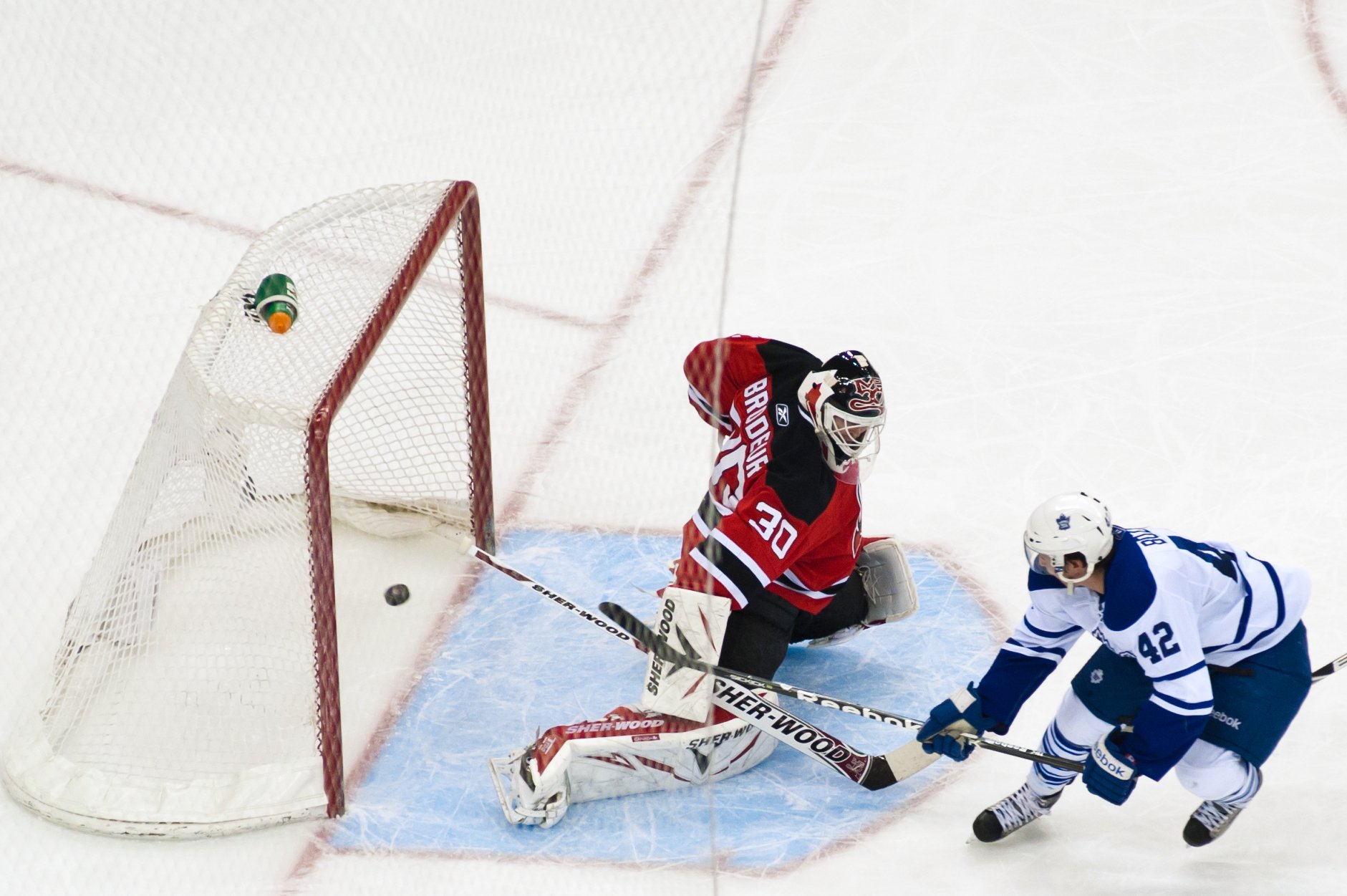
Photo: James DiBianco, Wikimedia Commons (BY-SA-2.0)
Maple Leafs Cap Space After Raddysh: $18.8M and a Centre-Sized Hole
Table of Contents
What the Maple Leafs cap space looks like after Raddysh
The Maple Leafs cap space sits at roughly $18.8 million with 19 contracts signed, according to PuckPedia, after John Chayka committed $8.5 million a year to Darren Raddysh in a sign-and-trade with Tampa Bay. That is the number that now governs everything Toronto does between the June 26 draft and July 1 free agency. It is a healthy figure on paper, and a tight one in practice, because the most obvious need — a top-six centre — is also the most expensive position to fill.
Toronto walked into the offseason with about $27.3 million in projected room against a cap that climbed to $104 million. The Raddysh deal ate a meaningful chunk of that. What is left has to cover a centre, depth additions, and the looming reality of a new Matthew Knies contract. The math is doable, but it is not the open-chequebook situation some fans imagined when the cap jumped.
Where the money went
Chayka has been busy, and most of his moves have been about the back end. He traded Joseph Woll to clarify the goaltending picture, locked up Raddysh as the top blueliner on the market, and continues to dangle Morgan Rielly, whose $7.5 million cap hit would reopen significant room if it moves. The Raddysh signing was the single biggest commitment, and it is the reason the projected space dropped from the high twenties into the high teens.
The Raddysh contract is also the move most likely to define Chayka's first offseason. Eight years and $68 million for a defenceman who broke out relatively late is a real bet, and we broke down both sides of it when the sign-and-trade landed. Whatever you think of the term, it removed the consensus top free-agent defenceman from the July 1 board and reset the rest of the market.
The centre problem is still the centre problem
For all the activity on defence, the Maple Leafs still need an impact centre, and that has not changed. The roster is heavy on wingers and short on middle-ice depth, a structural issue that predates Chayka. With roughly $18.8 million to work with, Toronto can afford a significant centre addition, but it cannot afford to be reckless, because that same pool has to stretch across multiple needs.
The internal candidates to address it are familiar. New York Rangers centre Vincent Trocheck has been linked to Toronto, and we made the case for him in our Trocheck breakdown. The trade route runs through younger names like Anaheim's Mason McTavish, who we examined in our look at the centre math. Each path has a different cost — Trocheck in dollars, McTavish in assets — and the cap number determines how much flexibility Chayka has to pursue either.
A thin free-agent class makes it harder
The cap space would mean more if the market were deeper. It is not. The 2026 UFA class is one of the weakest in years, with many stars having signed extensions before the season, and Raddysh's removal only thinned it further. Buffalo's Alex Tuch now headlines the group as a winger, not a centre, and the down-the-middle options on the open market are underwhelming. We flagged Tuch as a fit in our power-forward piece, but he does not solve the centre issue.
That dynamic pushes Chayka toward the trade market, where the real centre solutions live. It also explains the discipline. A GM with cap space in a thin market has to resist the urge to overpay a mid-tier free agent simply because the money is there. The smarter play is to hold powder for a trade, even if it means a quieter July 1 than fans want.
The Rielly variable
The single biggest swing factor in Toronto's cap picture is Morgan Rielly. Moving his $7.5 million cap hit — he has four years left and a no-movement clause — would push the Maple Leafs' available space well past $25 million and give Chayka the room to be genuinely aggressive. The San Jose Sharks have emerged as the team to watch, a situation we detailed in our Rielly trade update.
Until that resolves, the $18.8 million figure is the working number, but it is a number with a big asterisk. If Rielly waives and a deal gets done around the draft, the entire calculus changes, and Toronto could enter free agency as one of the more dangerous cap teams in the league. The full picture lives on our contracts page.
Don't forget the Knies raise
Any honest accounting of the Maple Leafs cap space has to leave space for Matthew Knies. Chayka just called a Knies trade 'not probable,' which means the franchise intends to pay him after a 66-point season. That raise is not in the current number, and it is a meaningful future commitment. Spending all of the available room this summer without leaving runway for Knies would be a planning error, and Chayka has shown no sign of making it.
This is the quiet tension under the whole offseason. The cap went up, but so did the obligations, and the bill for the young core is coming due. The discipline you are seeing now is partly about preserving the ability to keep that core intact.
The cap went up, but so did the bar
It is tempting to treat the $104 million cap as a windfall, but every team got the same raise. The cap going up does not give Toronto a competitive edge; it simply raises the price of everything. Free agents know the ceiling moved, agents have priced it into their asks, and the going rate for a useful centre or a second-pair defenceman has climbed accordingly. Real flexibility comes from cap space relative to the rest of the league, and on that measure Toronto is solidly middle of the pack until a move like a Rielly trade changes the equation.
That context is why the discipline matters so much. A team can have the eighth- or tenth-most cap space in the league and still feel pinched if its needs are concentrated at premium positions. The Maple Leafs' $18.8 million has to do heavy lifting, and spreading it thinly across several mid-tier additions would be the easiest way to waste it. One impactful centre is worth more than three depth signings, and the front office appears to understand that.
What's next
The next two weeks will tell the story. The draft on June 26 is unlikely to move the cap needle directly — entry-level deals are cheap — but it could be the venue for a Rielly trade or a centre acquisition. Then July 1 arrives, and we find out whether Chayka spends his $18.8 million on the open market or banks it for a bigger swing.
The smart bet, given the thin free-agent class and the looming Knies contract, is patience. Toronto has the room to make one significant addition without compromising its future, and the front office seems to understand that the centre fix is more likely to come by trade than by free agency. Keep tracking the moves on our team hub as the offseason accelerates.
Frequently Asked Questions
How much cap space do the Maple Leafs have after signing Raddysh?
The Maple Leafs have roughly $18.8 million in projected cap space with 19 contracts signed, according to PuckPedia, after committing $8.5 million per year to Darren Raddysh. Toronto entered the offseason with about $27.3 million against a $104 million cap.
What is the Maple Leafs' biggest need this offseason?
A top-six centre. The roster is heavy on wingers and thin down the middle, and the front office is expected to address it through the trade market given a weak 2026 free-agent class.
Who could the Maple Leafs target at centre?
Names linked to Toronto include Rangers centre Vincent Trocheck on the free-agent and trade market and Anaheim's Mason McTavish via trade. The cap number determines how much flexibility Toronto has to pursue either.
How would a Morgan Rielly trade affect Toronto's cap space?
Moving Rielly's $7.5 million cap hit would push the Maple Leafs' available space past $25 million. Rielly has four years left and a no-movement clause, and the San Jose Sharks have emerged as the team most likely to land him.
How much is the NHL salary cap in 2026-27?
The NHL salary cap rose to $104 million for 2026-27. The increase gave the Maple Leafs more room, but rising obligations, including a looming Matthew Knies raise, mean the space is tighter than the headline number suggests.
Will the Maple Leafs be aggressive in free agency on July 1?
Likely not aggressive on the open market. With a thin UFA class and a future Knies contract to plan for, the smarter approach is to bank cap room for a trade rather than overpay a mid-tier free agent.