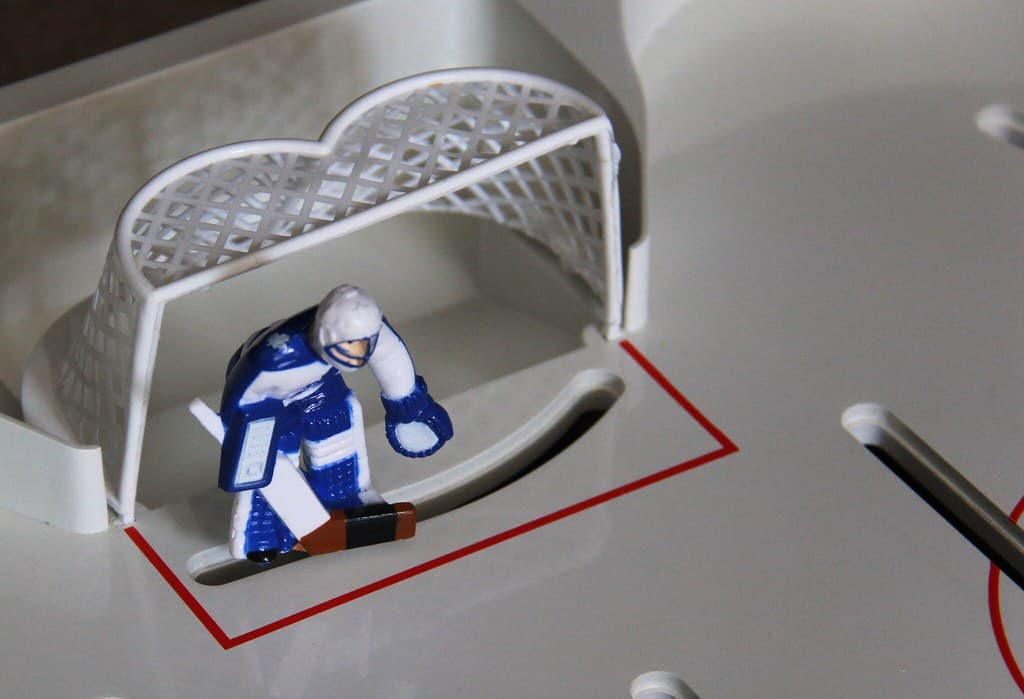
Photo: mrose.typespace, Flickr (BY-SA-2.0)
Opinion: The Maple Leafs Should Only Trade Anthony Stolarz for a Real Upgrade
Table of Contents
An Anthony Stolarz trade only makes sense as part of an upgrade
If the Maple Leafs trade Anthony Stolarz this summer, it should be because someone better is walking through the door — not because his name surfaced on a trade board during a busy draft week. That is the line in the sand worth drawing before the rumours run away from the facts. An Anthony Stolarz trade is only defensible if Chayka has already landed a genuine, proven starter to replace him.
The reporting that put Stolarz in play makes this exact point, almost in passing: he becomes available only if Toronto takes a big swing in goal and lands a name like Connor Hellebuyck or Adin Hill. That conditional is doing a lot of work, and Leafs fans should hold Chayka to it. Move Stolarz for an upgrade, fine. Move him to free up a roster spot or a few dollars, and you are solving a problem you do not have by creating one you will.
What Stolarz actually is
Two seasons tell two very different stories, and the truth sits between them. In 2024-25, Stolarz was one of the best goaltenders in hockey, leading the entire NHL with a .926 save percentage while going 21-8-3 with a 2.14 goals-against average. That is not a fluke line for a backup; that is starter-calibre, and on a Toronto team that needed exactly that, it was a revelation.
Then 2025-26 happened. Stolarz slipped to a .893 save percentage across 26 injury-marred games as the team in front of him fell apart and missed the playoffs. Pick whichever season fits your argument and you can call him elite or replaceable. The honest read is that he is a quality, occasionally excellent starter whose floor is tied to both his health and the structure in front of him. A goaltender does not go from leading the league to league-average without the team around him changing too, and Toronto's collapse last season was a full-roster failure, not a goaltending one.
The contract is the whole point
Here is what gets lost in the rumour churn: Stolarz is cheap. His four-year, $15-million extension carries a $3.75-million cap hit beginning in 2026-27. In a league where the cap is climbing to $104 million and competent starting goaltending routinely costs $6 million or more, a starter at $3.75 million is an asset, not a problem.
That is precisely why moving him only makes sense inside an upgrade. If you trade a $3.75-million starter and replace him with an $8-million one, you had better be certain the gap in performance justifies the gap in price — because that money comes straight out of a roster that already needs a centre and a more mobile defence. Our cap-space breakdown shows just how many holes that money could otherwise fill.
The Hellebuyck case versus the Hill case
Not all upgrades are created equal, and this is where the Stolarz debate gets interesting. Hellebuyck is a multiple-time Vezina winner and arguably the best goaltender on the planet. If Chayka could somehow pry him loose, you do the deal, move Stolarz to balance the books, and you have genuinely solved the position for years. That is a swing worth taking.
Adin Hill is a different conversation. Hill is a good, Cup-winning goaltender, but he is not a clear upgrade on a healthy Stolarz — he is closer to a lateral move at a higher price. Trading a cost-controlled Stolarz to bring in a comparable goalie for more money is the kind of activity that looks like progress and functions like a downgrade. The distinction matters: chase the elite tier, not the merely different.
The depth chart already has answers
Toronto is not thin in net, which weakens the case for forcing a move. The Leafs dealt Joseph Woll to the Flyers and brought back goaltending depth in the process, and the organization has spent the offseason sorting through a genuine crease logjam. We mapped the full picture in our look at the 2026-27 goaltending logjam, and the takeaway is that Stolarz sits at the top of a stable, affordable group.
You break up a stable, affordable group only when the alternative is clearly better. There is even a separate flirtation with veteran Sergei Bobrovsky that we examined in our piece on Chayka's crease hunt — interesting, but again, only if it represents a real upgrade rather than a sideways shuffle of names.
The playoff-goaltending trap
Toronto's relationship with its goaltenders is its own genre of heartbreak, and that history warps the analysis. Every spring without a deep run gets retroactively pinned on the crease, fairly or not, and every offseason brings a fresh push to chase a name-brand starter who will finally settle the position. It is a seductive story, and it has cost the franchise picks and money before.
The trap is mistaking activity for improvement. A healthy Stolarz at $3.75 million is not the reason this team has fallen short in the playoffs — the scoring depth, the blue-line mobility and the structure under new head coach Jim Hiller matter far more. Spending the team's cheapest competitive advantage to address a position that is not actually broken is how you end up worse while feeling busier. If goaltending is the hill Chayka wants to climb, the climb has to end at a clearly better goaltender, full stop.
Why the temptation exists at all
To be fair to Chayka, the impulse is understandable. He inherited a roster that won a lot of regular-season games and almost nothing in the spring, and goaltending has been a convenient scapegoat in Toronto for two decades. There is a worldview in which you decide your window is now, you bet everything on elite goaltending, and you accept the cost. If that is the plan, Stolarz is a logical chip.
But that worldview only holds if the goaltender coming back is demonstrably better and the price is sane. Otherwise you have taken one of the few genuinely good-value contracts on your roster and spent it on the illusion of action. This front office has earned some trust with decisive, coherent moves so far. The Stolarz question is a chance to prove that discipline cuts both ways — that knowing when not to trade is part of the job too.
What's next
Watch the order of operations. If a starter arrives first and Stolarz follows, the process worked as intended. If Stolarz moves before a clear upgrade is in hand, that is the version Leafs fans should worry about. The draft floor and the days before July 1 are when this resolves, and it slots into the wider trade picture we are tracking.
The bar is simple. Trade Anthony Stolarz for Connor Hellebuyck and you have upgraded a contender. Trade him for anything less and you have talked yourself into a problem. Chayka has been bold all summer. Here, the bold move and the right move might just be patience.
If you are mapping the broader board this weekend, our running coverage of the Leafs' draft-floor trade rumours and the June 29 qualifying-offer deadline rounds out the picture. The goaltending question does not exist in isolation — every dollar Chayka does or does not spend in net ripples through a roster that still needs a centre and a faster blue line.
Frequently Asked Questions
Are the Maple Leafs trading Anthony Stolarz?
Not necessarily. Reports suggest a Stolarz trade only becomes likely if Chayka first lands a proven starter such as Connor Hellebuyck or Adin Hill. As of draft weekend, no deal has been made and Stolarz remains Toronto's projected starter.
What is Anthony Stolarz's contract with the Maple Leafs?
Stolarz signed a four-year, $15-million extension carrying a $3.75-million cap hit that begins in 2026-27 and runs through 2029-30. That below-market price for a starting goaltender is a key reason he is so valuable to keep.
How good was Anthony Stolarz in 2024-25?
Excellent. Stolarz led the entire NHL with a .926 save percentage in 2024-25 while going 21-8-3 with a 2.14 goals-against average, establishing himself as a legitimate starting goaltender for Toronto.
Why did Anthony Stolarz's numbers drop in 2025-26?
Stolarz posted a .893 save percentage in 26 games during an injury-marred 2025-26 season as the team in front of him struggled and ultimately missed the playoffs. His health and the team's defensive structure both contributed to the decline.
Would Connor Hellebuyck be an upgrade over Stolarz for the Maple Leafs?
Yes. Hellebuyck is a multiple-time Vezina Trophy winner and one of the best goaltenders in the world. If Toronto could acquire him, trading Stolarz to balance the cap would be justified as a genuine upgrade at the position.
Should the Maple Leafs trade Stolarz for Adin Hill?
It is debatable. Hill is a good, Cup-winning goaltender but not a clear upgrade on a healthy Stolarz, and he would likely cost more. Trading a cost-controlled Stolarz for a comparable goalie at a higher price would be closer to a lateral move than an improvement.
Do the Maple Leafs need to trade a goalie this summer?
Not out of necessity. After trading Joseph Woll to the Flyers and sorting through their crease depth, the Leafs have a stable, affordable goaltending group led by Stolarz. A trade only makes sense if it clearly upgrades the position.